Understanding Power of Attorney Across the UK: England & Wales, Scotland, and Northern Ireland
I am mindful that when I write about Lasting Power of Attorney, it is always through the lens of law as it stands in England and Wales. While the concept is similar across the UK, the rules and terminology differ depending on whether you live in England & Wales, Scotland, or Northern Ireland.
This brief blog explores those differences.
England & Wales
In England and Wales, there are two main types of Power of Attorney and these are known as Lasting Powers of Attorney (LPAs):
1. Property and Financial Affairs LPA
This allows your attorney to manage things like:
Bank accounts
Paying bills
Selling property
It can be used while you still have mental capacity, with your permission if that is set out when drafting the document.
2. Health and Welfare LPA
This covers decisions such as:
Medical treatment (to consent to or refuse treatment)
Care arrangements
Life-sustaining treatment (if explicitly stated, or “Option A” has been ticked)
This type only comes into effect if you lose mental capacity.
Key Points
LPAs must be registered with the Office of the Public Guardian before use.
You can appoint more than one attorney.
Replacement Attorneys can be included in the document
You can include specific instructions or preferences.
You must be over the age of 18 to create a Power of Attorney.
You can find out more at: Make, register or end a lasting power of attorney
Scotland
Scotland uses a slightly different system under the Adults with Incapacity (Scotland) Act 2000. Powers of Attorney are generally grouped into:
1. Continuing Power of Attorney (financial)
Similar to the financial LPA in England and Wales, this covers:
Financial matters
Property management
It can start immediately or only upon incapacity.
2. Continuing Power of Attorney (welfare)
Equivalent to a health and welfare LPA, this covers:
Personal care
Medical decisions
Combined Powers
In Scotland, it’s common to create a combined Power of Attorney covering both financial and welfare matters in one document (this isn’t possible in England and Wales).
Key Points
Must be registered with the Office of the Public Guardian (Scotland).
You can create a Power of Attorney with a solicitor or buy a pack.
Requires a certificate from a solicitor or doctor confirming capacity.
You must be over the age of 16 to create a Power of Attorney.
You can find out more at: mygov.scot and Office of the Public Guardian: Scotland
Northern Ireland
Northern Ireland currently uses an Enduring Power of Attorney system
Enduring Power of Attorney (EPA)
This applies only to:
Property and financial affairs
It allows your attorney to manage your finances and can continue after you lose capacity.
Health Decisions
Unlike England, Wales, and Scotland, Northern Ireland does not yet have a formal equivalent for health and welfare PoA (although reforms have been discussed).
Key Points
EPAs must be registered when the Attorney(s) believe the Donor is or is becoming mentally incapable the donor starts to lose capacity.
No separate legal document for health and welfare decisions currently exists.
You can find out more at: Information on Enduring Powers of Attorney (EPA)
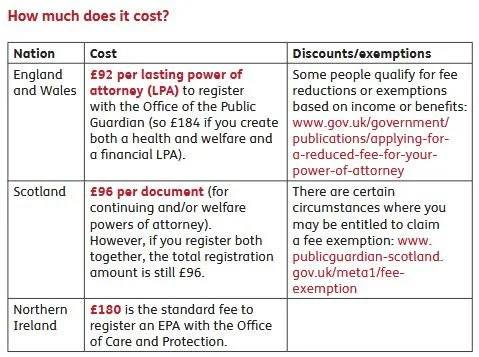
Costs of Power of Attorney across the nations
I am grateful to Carers UK and Standard Life for the super initiative of Power of Attorney Day. You can access the resource for the day which includes a summary of costs, shown below:
Find out more
This blog has been written to raise awareness of the differences across the nations and it has been interesting to learn some of the differences. For detailed information on the different nations, please access links in the blogs.
For support making your Lasting Power of Attorney contact me today.
To find out more about my Lasting Power of Attorney service, Advance Care Planning Education or support for people facing a life changing diagnosis, contact me
If you have received in formation from any of the content and would like to support my ongoing work, head to Buy me a coffee – thank you.