
Guess the word
This blog is about a word I hear many times when people are thinking about making a Lasting Power of Attorney. In my experience, it is a reason many people cite as a fear and reason for not making a Lasting Power of Attorney.
Can you guess the word?
…Suspense and drum roll noise…
The word is control. I hear time and time again statements like, “I want control so I don’t want a Lasting Power of Attorney,” or “I don’t want to lose control”.
The reality
Paradoxically, the impact of having a Lasting Power of Attorney gives, I believe, exactly the opposite. Having a Lasting Power of Attorney in place gives rather than takes away control. In this blog I will set out why I make this bold statement.
Before I do that, I will start be setting out what a Lasting Power of Attorney is. Then I’ll explain why a Lasting Power of Attorney gives rather than takes control. The blog will include steps on how to make a Lasting Power of Attorney.
What is a Lasting Power of Attorney?
A Lasting Power of Attorney is a legal document that enables you to appoint one or more people to support you to make decision or to make decisions in your best interests if you lose mental capacity. There are two types of LPA:
Health and Welfare LPA: This allows your attorney to make decisions about your personal healthcare and welfare, such as daily care, medical treatment, and life-sustaining treatment.
Property and Financial Affairs LPA: This allows your attorney to manage your financial matters, including paying bills, managing bank accounts, and selling property.
The person making a lasting power of Attorney is called the donor and the person or people appointed to support the donor make decisions are called attorneys.
It's possible to set up one or both types of LPA depending on your needs, most people complete both at the same time. I have written extensively about Lasting Power of Attorney and you can find out more by searching “Lasting Power of Attorney” in the blog section of my website.
Moving on now to the reasons why I argue a Lasting Power of Attorney gives rather than takes control.
Law
I guess the most important place to start is the law under which Lasting Powers of Attorney operate. The legal framework, or law, in this case is the Mental Capacity Act 2005. The principles of the Act start with assuming we have capacity which is an important message to hear – there is no requirement to “prove” capacity, something I know many people are afraid of. Having mental capacity is time and decision specific, and it’s not as easy as saying someone does or does not have capacity.
The principles of the Metal Capacity Act are listed below.
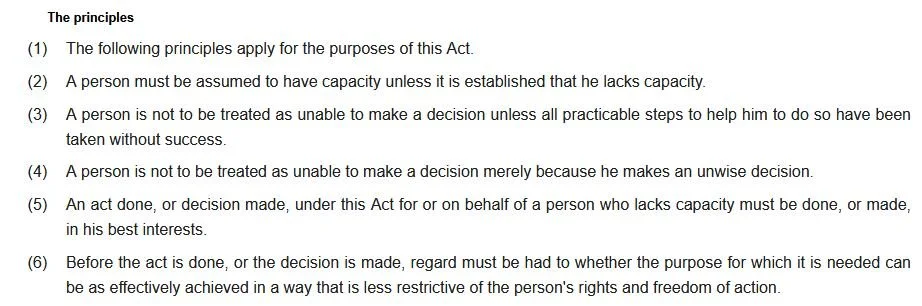
Principles of The Mental Capacity Act 2005
Translating this to Lasting Power of Attorney, there are two important messages. Firstly, a Lasting Power of Attorney for Health and Welfare can ONLY take effect on loss of capacity – all the while we have capacity, we make medical decisions to consent for or refuse to have treatment ourselves. A Lasting Power of Attorney, for a capacitous person, does not alter that – it is there for a point in the future when capacity may be lost. Many people think that having a Lasting Power or Attorney suddenly means their attorneys suddenly “take over”, but this is not true and is protected by law.
What the Lasting Power of Attorney does do is to give control, it gives you the control to decide who you would like to support you to make decisions or make decisions in your best interests for you if you were to lose capacity. Without a Lasting Power of Attorney in place, you may have a Court Appointed Deputy .
The second key message relates to Lasting Power of Attorney for Property and Finance. When the document is drafted there is a choice on when it could take effect, either as soon as it is registered and loss of capacity, or on loss of capacity only.
The wording looks like this on the Lasting Power of Attorney:
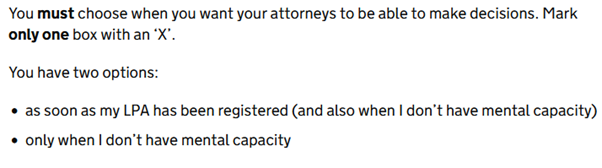
When attorneys can act (for Property & Finance)
The word to hone in on is could – and this means attorneys could not should act. Choosing the option that attorneys could act as soon as the document is registered simply means the option is there for the attorneys to act, not that they must act.
Why might this be useful? I’ll translate the words into more meaningful situations to help explain. If you have an accident, for example, and are in hospital for some length of time you may be mentally able to do financial tasks, but not physically able. If your attorneys could act as soon as the Lasting Power of Attorney is registered, this means that your attorneys could step in and support you for the time you are in hospital.
Another good example is thinking of a parent who gradually wants to hand over or finances to their attorney – having the Lasting Power of Attorney immediately effective means that donor and attorney can manage accounts and finances side by side.
Returning to the Mental Capacity Act, it is there to protect the donor, any attorney acting nefariously and not in the donor’s best interests could potentially could be reported to the Court of Protection.
People you trust
My next argument for gaining control is that attorneys should be people you trust. I often hear people say, “I ought to chose my son/daughter….but ….” There is no ought to when making a Lasting Power of Attorney – you chose from the beginning the people you trust not the people who expect to be your attorneys.
You can also revoke attorneys, (while you have capacity), something I have written about here.
Supplementary Planning Ahead
For my third thought on why Lasting Power of Attorney gives rather than takes control, I’ll highlight the role of Advance care Planning. As part of planning ahead, documenting What Matters Most to you is a valuable exercise and gives a guide to your attorneys about the things that are important to you. Documenting your wishes provides a blueprint if decisions ever need to be made in your Best Interests, something I’ll expand on in the following section.
Books such as My Future Care Handbook provide space for you to you ensure your preferences are known if you lose capacity and decisions need to be made in your Best Interests. Making your Lasting Power of Attorney can be a great catalyst to starting these Important Conversations – and to gaining control.
Best Interests
I have mentioned Best Interests in the previous section and can explain more here. Best Interests, in relation to the law and the Mental Capacity Act, sets out clear principles which must be followed if decisions need to be made in someone’s Best Interests.
You can read about Best Interests (in the Mental Capacity Act 2005) in full here and I will highlight one of the principles next as an example. Section 4 (6) the Act sets out the importance of finding out a person’s beliefs, values and written statements as part of any decision-making process.
You can see wording of the Mental Capacity Act 2005 below:

From the Mental Capacity Act Best Interests principles.
When it comes to signing the documents, I stress that attorneys are there to support a donor and not to make a decision that they, (the attorney), would choose.
The Court of Protection
If there is a dispute or concern that an attorney is not acting in the Best Interests of a donor, an application can be made to the Court of Protection. The Court has authority to decide if adults have mental capacity for key decision making and to make decisions in a person’s Best Interests if they are found to lack capacity.
The excellent Open Justice Court of Protection Project provides a wealth of information about the Court of Protection as well as resource in the form of blogs.
I have described the reasons I believe a Lasting Power of Attorney gives, not takes control - the next section focuses on how to make a Lasting Power of Attorney.
How to make a Lasting Power of Attorney
There are three ways of making a Lasting Power of Attorney; a DIY approach, using a solicitor or using a Lasting Power of Attorney Consultant . Like everything, there are pros and cons to each choice and it is worth researching to find out the option that works best for you.
It is important to compare the options and ensure you chose which is most suited to your needs. I have written before about making a Lasting Power of Attorney and highlight key points below.
1. The Do It Yourself option to making a Lasting Power of Attorney
The DIY option means you will use the GOV.UK website to access the forms. You can do this either electronically or download and print the forms. I’d recommend the digital approach as it is quicker and easier to track the progress of the application. You will need to ensure all information is correct and within the legal boundaries and that the signatory process is completed in the correct order.
If you use the forms digitally they will still need printing for the signatory stage.
2. Using a solicitor to make a Lasting Power of Attorney
You can opt to use a solicitor to draft your Lasting Power of Attorney. Some people may do this at the same time as drafting a will with their solicitor. Each company will have their own process and they can be valuable in the case of a complex Business Lasting Power of Attorney for example.
3. Using a Lasting Power of Attorney Consultant to make a Lasting Power of Attorney
The Lasting Power of Attorney Consultant approach involves engaging an independent consultant to draft the Lasting Power of Attorney. You will need to check out how the consultant works and what is included in the costs. Using an independent consultant can give peace of mind and an individualised service. It’s more expensive than the DIY approach but likely to be significantly less than a solicitor. I have described in an earlier blog how I work as a Lasting Power of Attorney Consultant.
Closing thoughts
I started this blog describing loss of control as a perception people worry about or give as a reason not to make a Lasting Power of Attorney. I have included five points that I believe show how having a Lasting Power of Attorney in place gives rather than takes control, starting with the law and ending with The Court of Protection.
Does any of this resonate with you or people you care for?
For support making your Lasting Power of Attorney contact me today.
To find out more about my Lasting Power of Attorney service, Advance Care Planning Education or support for people facing a life changing diagnosis, contact me
If you have received in formation from any of the content and would like to support my ongoing work, head to Buy me a coffee – thank you.